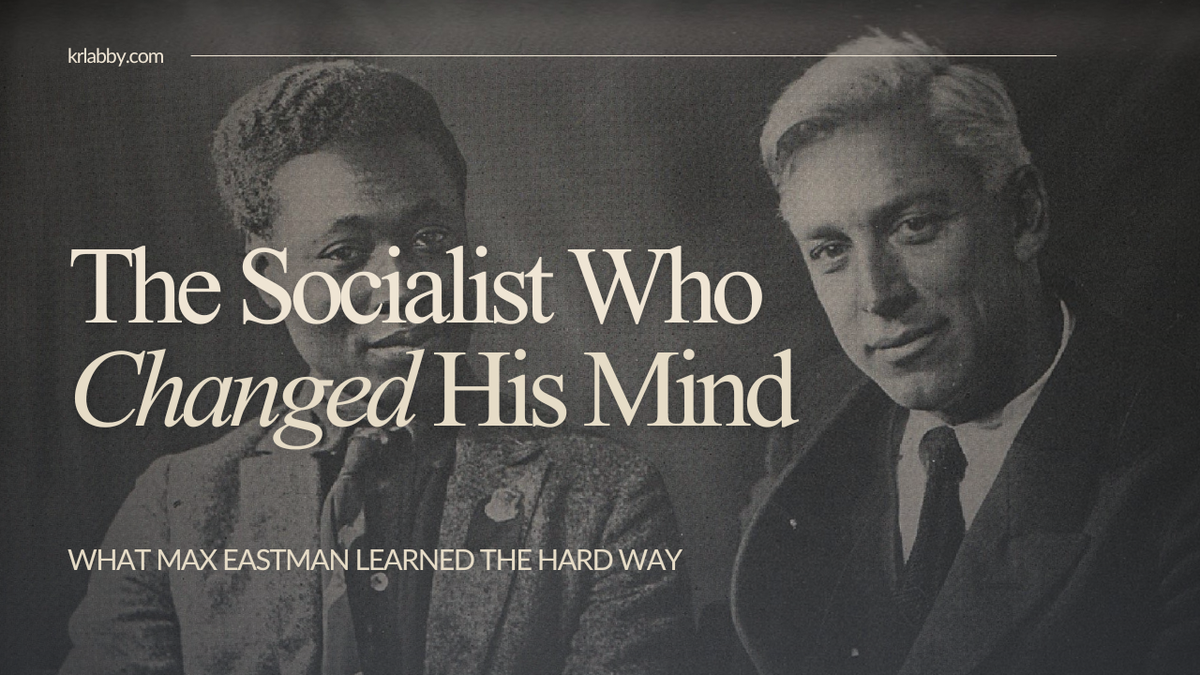
The Socialist Who Changed His Mind: What Max Eastman Learned the Hard Way
Eastman was not guessing what concentrated power does to a country. He watched it happen in real time.
Capitalism is suffering in the polls these days. Favorable views have dropped from a wide lead in 2019 to a near-coin flip today. Much of that shift exists beyond the more predictable places; even Republicans are souring on the free market.¹ Perhaps not surprisingly, socialism is enjoying an apparent resurgence.
I grew up in the Cold War. I cheered when Rocky, wearing red, white, and blue shorts, knocked out a genetically modified Soviet supervillain. I remember looking out my classroom window, waiting for Red Dawn-style communist paratroopers to land in the adjacent cow pasture. I laughed when a Wendy's commercial featured a Soviet fashion show: a parade of Russian women wearing the same drab, burlap dress as daywear, eveningwear, and swimwear.
All of that is to say that when many younger people, and a bunch of Gen Xers who, at least in my opinion, should know better, start harboring sympathy for socialism, I start hearing "Eye of the Tiger" in the background. I then reach for some books in need of a resurgence.
A staple of this genre is Max Eastman's Reflections on the Failure of Socialism. What makes Eastman so fascinating is that he spent much of the early twentieth century as a vigorous proponent of socialism. He edited radical magazines, admired Russian revolutionaries, and even spent considerable time in Russia to see the revolution up close. Eastman wasn't a Starbucks Marxist in a Che Guevara t-shirt; he was the real deal.
This is what makes Reflections on the Failure of Socialism so worthwhile. Eastman wasn't a pundit popularizing scripted talking points and peddling pre-determined conclusions. He was a once-true believer who saw socialism take a dark turn, a turn he came to believe was an inevitable feature, not an avoidable flaw, of the system. Reading him as a Christian, I also find that his secular analysis of human nature and power unexpectedly illuminates deeper theological questions about the limits of rearranging external conditions.
His book moves through three connected stages: his own history as a radical, the economic argument that grew out of that history, and a sobering analysis of human nature and belief. The three conclusions that follow are not independent talking points. Each one is forced by the one before it.
A True Believer
As editor of The Masses and later The Liberator, Eastman was one of the sharpest pens the American left had. When the Bolsheviks took power in Russia in 1917, he greeted Lenin in print as "a Statesman of a New Order" and dedicated himself "with no doctrinal reservations to the defense of his principles of action and his Soviet regime."²
His commitment wasn't content to stay on the sidelines in New York. He went to Russia in 1922, arrived in time to learn a little Russian before attending the fourth congress of the Third International, and by his own admission was "going over to find out whether what I have been saying is true."³
What he found instead was the disturbing groundwork for Stalin's rise to power and a brutal, increasingly totalitarian regime. The Bolshevik plan had always rested on the idea of a "vanguard," a small, disciplined party acting on behalf of the working class until the workers were ready to rule themselves. Eastman watched as, under Stalin, this same vanguard executed "a plot by which Stalin made himself master" after Lenin's death.⁴
The same machinery built to hand power to the working class turned out to work just as well for consolidating power in the hands of a single man once Lenin was gone. Eastman came to see that device accomplishing the opposite of its stated intent. "Instead of liberating the mind of man," he wrote, "the Bolshevik Revolution locked it into a state's prison tighter than ever before."⁵
As Eastman explored the movement at ground level, he expected that some trace of socialist benefit would appear once Russia's capitalists were expropriated and the state took over production. He looked for it. He didn't find it. "It seemed perfectly clear," he later recalled, "that if the socialist hypothesis were valid in general, some tiny shred of the benefits promised by it would have appeared." Out of this experience he concluded that "the whole idea of extending freedom... through common ownership of the means of production was a delusive dream, a bubble that had taken over a century to burst."⁶
That personal collapse of confidence did not remain private. It forced Eastman to ask a harder question: what does a state actually have to become once it takes charge of an entire economy? The answer he reached forms the first of his three lasting conclusions.
First: The Market as Guardian of Liberty, Not Just Efficiency
Eastman saw firsthand what a state does once it takes over an economy. A government in charge of production requires the authority of a business executive over every aspect of the enterprise, including the people. That authority does not stay neatly confined to economics. It spreads into politics, speech, and elections, because a planned economy cannot tolerate deviation from the plan or organized opposition to it. He points to the one-party ballot as intrinsic proof: "The phony elections in totalitarian countries, the ballots with only one party and one list of candidates, are not the mere tricks of a cynical dictator—they are intrinsic to a state-planned economy."⁷
Nicaragua supplied a fresh illustration of the pattern in July 2026, when President Daniel Ortega declared, "There will be no more elections here so that they [the opposition parties] can try to seize the government, seize power." The parallel is not perfect, Ortega's regime is a hybrid of personalist rule and socialist rhetoric, but the underlying logic Eastman identified still holds: once organized opposition is treated as an existential threat to the plan, the ballot itself becomes an early casualty.⁸
Against this, Eastman insists that a market economy spreads decisions across millions of people, none of whom can unilaterally boss the rest. The choice is stark: either goods are produced and distributed through "the impersonal mechanism of the market, issuing its decrees in the form of fluctuating prices," or they are produced and distributed by "commands issuing from a personal authority backed by armed force." There is no stable middle option in which a government runs the entire economy while leaving the people in it free.⁹
That is why Eastman argues a free society needs multiple competing centers of power: labor, capital, government, church, press, each strong enough to check the others. He has no patience for the anarchist hope that abolishing the state will leave people cooperating peacefully on their own. The state must be limited by other genuine powers, not wished away. "The state... must be regarded as but one of those social forces upon whose equilibrium a free society depends."¹⁰
Eastman also rejects the idea that private property is a capitalist invention. He viewed the drive to own as closer to instinct: "a robust instinct extending far and wide in the animal kingdom."¹¹ Given that reality, a society has two real options for dealing with unequal property: place it under state control, or spread ownership more widely so more people hold a stake. He preferred the second.¹²
"No one need starve, no one need be destitute, in order to preserve the sovereignty of the market."¹³
For Eastman, society can chase perfect economic equality or it can keep people free. Not both. "In no conceivable society can men be in the economic sense both equal and free."
If the logic of comprehensive economic planning itself requires authoritarian control, a second question immediately follows: can a gentler, democratic version of socialism escape that logic?
Second: Socialism and Communism, Related Roots, Same Institutional Logic
Eastman will not let democratic socialists off the hook merely because they are, rightly, horrified by Soviet violence. Theoretical socialism typically begins as something gentler: shared ownership pursued by persuasion rather than force. Communism is what happened once that hope hardened into a rigid theory of history and was handed to men willing to use guns to make it real.¹⁴
Eastman does not claim the two are identical in moral atmosphere or temperament. He does argue that they share the same institutional destination. Whether the state economy arrives by ballot or by revolution, it requires continuous, centralized authority to function. The democratic socialist and the Bolshevik may differ sharply in method and scruple, yet both pursue a structure in which the state takes charge of the decisive means of production. "Whether... hard-headed Bolsheviks, soft-headed Social Democrats, or genteel liberals," thoroughgoing socialism tends toward "either phony elections or no elections at all."¹⁵
This is Eastman's sharpest critique of the liberals of his day: they cheered economic centralization while insisting it had nothing to do with the totalitarianism they claimed to hate.¹⁶ The reason the two keep converging is not mere historical accident. A planned economy works only if the plan is followed, and organized dissent is precisely what prevents a plan from being followed. A government that begins by promising modest democratic control over a few industries eventually faces the industries it has not yet touched, the prices it has not yet set, and the critics who note that the plan is not delivering. At each stage the easiest "fix" is more control. That is how a program that starts at the ballot box can drift, emergency by emergency, toward the same concentration of power Eastman watched Bolshevism reach by force.
If both the hard and soft versions of the project tend toward the same institutional outcome, the deeper problem may not be merely institutional. It may lie in the assumptions about human nature and morality that underwrite the entire enterprise. That brings Eastman to his third and most unsettling conclusion.
Finally: A Different Religion Underneath the Economics
Eastman's ultimate target is Marxism itself, the theory that supplied both socialism and communism with their intellectual architecture. He came to see it functioning less like an economic hypothesis and more like a religion. Marxism teaches that history is moving, on its own, toward one inevitable outcome: a classless society. Believers are called to work toward that outcome the way a religious believer works toward salvation.¹⁷
It is a religion with the moral logic inverted. Eastman contrasts it sharply with Christianity: the vital difference is between "a religion which teaches personal salvation through sympathy and loving-kindness" and "a religion which teaches social salvation through bringing the morals of war into the peacetime relations of men." Once salvation is relocated to a future social order, almost anything, deceit, character assassination, the withholding of truth, can be justified if it advances the cause. He quotes the principle bluntly: "For us morality is subordinated completely to the interests of the class struggle of the proletariat." He calls the result "the religion of immoralism."¹⁸
Eastman remained a secular writer. He never framed his critique in confessional language. Yet his diagnosis of human nature aligns, in striking ways, with a Christian anthropology. Marxism assumes human nature is infinitely plastic, a product of economic conditions, fixable once the conditions change. "All history," Marx claimed, "is nothing but a continual transformation of human nature." Eastman replies that socialism "assumed a greater self-dependence, as well as a more peaceable disposition, than these human animals are born with." The ideal society, he insists, "must be adapted to the unideal man."¹⁹
From a Christian vantage point, that observation is not merely political. Christianity assumes something still less flattering: the human heart is broken, and no rearrangement of property repairs what is actually wrong with us. Eastman does not say this. He does not need to. His secular argument already shows that socialism repeatedly fails to reckon with the limits of human nature. For the Christian reader, those limits point beyond economics to the deeper problem of sin and the necessity of a Savior rather than a revolution.
That is why neither socialism nor communism ultimately fits easily with a Christian view of the world. The economics are only part of the difficulty. Underneath them sit a different doctrine of history, a different diagnosis of the human condition, and a different story about what finally sets things right.
Why This Still Matters
Eastman was not guessing what concentrated power does to a country. He watched it happen in real time.
Perhaps that is the piece still missing from the current conversation. Fewer and fewer Americans know the horrors of communism firsthand. Many never watched the Berlin Wall fall, never learned what the Stasi did to East Germans who criticized the regime at their own kitchen tables, never studied the gulag system that swallowed millions, or the killing fields of Cambodia, where an attempt to build an agrarian socialist utopia left roughly a quarter of the population dead within four years. Even now, Cubans stand in ration lines and millions of Venezuelans have fled a collapsed economy. These are living footnotes to the argument Eastman made seventy years ago.
For Christians thinking through political economy, Eastman remains a useful conversation partner precisely because he is not utopian in either direction. He knows capitalism presents real challenges and is far from flawless. His claim is narrower, and stronger for it: a market economy, whatever its flaws, disperses power in a way that supports human liberty. A planned economy, however good the intentions behind it, concentrates power in ways history has shown, again and again, lead to the loss of rights, freedom, dignity, and human flourishing. And underneath the politics and the economics lie competing claims about human nature and moral order, one of which sits far more comfortably with the Christian faith than the other.
Eastman's final practical counsel, delivered in an address to the American Federation of Labor, still lands cleanly: "Don't kill the goose that lays the golden eggs... Capitalism... is the only creature on this earth that ever laid golden eggs, and in my humble but mature opinion she's the only one that ever will."20
Want the whole book? Get your free copy at the Foundation for Economic Education (FEE). No affiliation, I just like what they do.
Notes
- Aaron Blake, "Americans — Including Many Republicans — Are Losing Faith in Capitalism, Polling Shows," CNN, July 23, 2026, https://www.cnn.com/2026/07/23/politics/republicans-capitalism-socialism-poll.
- Max Eastman, Reflections on the Failure of Socialism (New York: Devin-Adair, 1955; digital ed., Foundation for Economic Education, 2016), Biographical Introduction.
- Eastman, Reflections, Biographical Introduction.
- Eastman, Reflections, Biographical Introduction.
- Eastman, Reflections, Biographical Introduction.
- Eastman, Reflections, Biographical Introduction.
- Eastman, Reflections, chap. 1, "Both Hopes Are False."
- "Nicaragua's President Says Country Will Not Hold Any More Elections," The Guardian, July 20, 2026, https://www.theguardian.com/world/2026/jul/20/nicaraguas-president-says-country-will-not-hold-any-more-elections.
- Eastman, Reflections, chap. 2, "Freedom and the Planned Economy."
- Eastman, Reflections, chap. 3, "The Real Guarantee of Freedom."
- Eastman, Reflections, chap. 4, "Replacement for the Dream We Lost."
- Eastman, Reflections, chap. 4, "Replacement for the Dream We Lost."
- Eastman, Reflections, chap. 2, "Freedom and the Planned Economy."
- Eastman, Reflections, chap. 1, "Both Hopes Are False."
- Eastman, Reflections, chap. 1, "Both Hopes Are False."
- Eastman, Reflections, chap. 1, "Both Hopes Are False."
- Eastman, Reflections, chap. 7, "The Religion of Immoralism."
- Eastman, Reflections, chap. 7, "The Religion of Immoralism."
- Eastman, Reflections, chap. 10, "Socialism and Human Nature."
- Eastman, Reflections, chap. 11, "Don't Kill the Goose" (An Address to the American Federation of Labor).
Bibliography
Blake, Aaron. "Americans — Including Many Republicans — Are Losing Faith in Capitalism, Polling Shows." CNN, July 23, 2026. https://www.cnn.com/2026/07/23/politics/republicans-capitalism-socialism-poll.
Eastman, Max. Reflections on the Failure of Socialism. New York: Devin-Adair, 1955. Digital edition: Foundation for Economic Education, 2016.
The Guardian. "Nicaragua's President Says Country Will Not Hold Any More Elections." July 20, 2026. https://www.theguardian.com/world/2026/jul/20/nicaraguas-president-says-country-will-not-hold-any-more-elections.