The Economist Who Called the Bluff: What Ludwig von Mises Knew About Envy
Mises was not guessing what planned economies do to people who ask the wrong questions. He had been one of them.
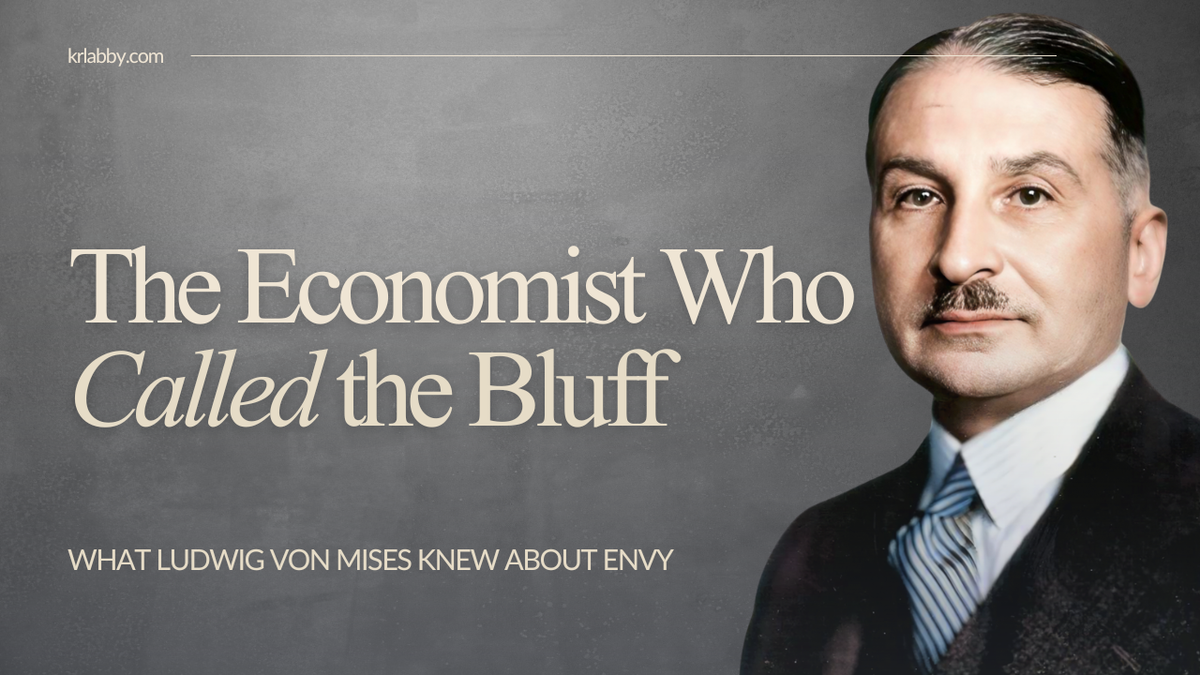
The Wall Street Journal’s student-written “Future View” column asked this month why democratic-socialist candidates do so well with people their age. One contributor said the quiet part almost aloud. Kathleen Keesey, a finance major at the University of Colorado Boulder, wrote that democratic socialism offers young voters an alternative to hard work: simply “having a capitalist system to blame for any societal economic woes.”¹ She was not citing Ludwig von Mises, but she sounded a good deal like him. Seventy years earlier, in a short book called The Anti-Capitalistic Mentality, Mises had already written the theory down.
It is a fitting companion to the polling. Favorable views of capitalism have fallen from a wide lead in 2019 to a near-coin flip today, and the shift is not confined to the usual places. Even Republicans are souring on the free market.² Socialism is enjoying a moment, and not only in surveys. It is showing up in ballots cast by people young enough to have little personal experience with socialism and its steep cost.
Mises was not so naive. He wrote the book as a man already chased across two countries by the systems he was diagnosing. He was not guessing what planned economies do to people who ask the wrong questions. He had been one of them.
His book runs five chapters, but the argument comes down to three moves. First, why people resent the market. Second, what the market actually is, and what it is not. Finally, what truths answer that resentment. Each move sets up the next.
A Man Who Paid to Learn the Lesson
Mises was born in 1881 in Lemberg, at the ragged eastern edge of the Austro-Hungarian Empire, and trained in Vienna under Carl Menger’s young Austrian school.³ By day he advised the Vienna Chamber of Commerce; by night he ran a private seminar that trained a striking share of the next generation of serious economists, Friedrich Hayek among them.⁴
The dark century soon caught up with him. Sensing the gathering storm of fascism, he fled Vienna for Geneva in 1934. He was right: when Austria fell to the Nazis in 1938, the Gestapo searched for him specifically and ransacked the apartment he had left behind. Two years later, as German forces swept through France, he escaped Europe entirely, arriving in New York in 1940 and rebuilding a career from nothing at fifty-eight.⁵ His stolen papers later surfaced in a former Soviet archive in Moscow—ironically catalogued and preserved by the very kind of state he had spent his life warning against.
By 1956, when he wrote The Anti-Capitalistic Mentality, Mises was no detached observer. He had already paid for the alternative.
First: Envy Dressed as Philosophy
The book’s central claim can be stated in a sentence: under an unhampered market economy, a man’s failure to get what he wants is his own responsibility, not the system’s.⁶ In a status-based society, a peasant’s son stays a peasant, and there is no shame in that, since birth decided it before he had any say. Capitalism removes the excuse. It rewards whoever serves the paying public best, so whoever fails to grow rich, or famous, or acclaimed must face the possibility that the market judged him correctly. It's his fault, no one else's. Mises thought most people would rather blame the system than accept that judgment. So they translate the complaint. Instead of saying “I failed,” they say “the market is unjust.”
Mises is describing a psychological pattern. Scripture shows its ancient root. When Adam is confronted, he answers, “The woman whom you gave to be with me, she gave me fruit of the tree, and I ate.” Eve replies, “The serpent deceived me, and I ate” (Gen. 3:12–13). The first human response to failure is to shift responsibility. The anti-capitalistic mentality is a later version of the same move.
That claim has a limit. Mises is describing what he calls an unhampered market—one “not sabotaged by government-imposed restrictions.”⁷ By this he means the social system of the division of labor under private ownership of the means of production, free of coercive interference. Where a tariff shields a weak competitor, where a subsidy keeps a favored firm alive past what customers would pay, or where occupational licensing and regulatory capture protect incumbents from new entrants, his diagnosis flips. That is not capitalism working. That is capitalism rigged, and a person blaming that arrangement is not scapegoating. He identifies true injustice: an outside hand tilting a game in its favor.
A skeptic will object that this is too convenient, that defining capitalism narrowly lets it dodge every failure the way “not real socialism” lets central planning dodge its own. Fair enough. But the two objections are not the same. Central planning drifts toward concentrated control by its own internal logic: someone has to decide what gets made, so power accumulates at the center almost by definition. Rigging works differently. A tariff, a subsidy, or a licensing barrier does not arise from two people trading value for value. Someone has to reach outside the transaction and borrow the state’s coercive power. Mises makes nearly this point in his chapter on the reactionary spirit: guilds blocked newcomers, farmers demanded tariff protection, and threatened incumbents sought government favor—all reaching for the state because the market would not give them what they wanted.⁸ Cronyism is not capitalism’s destination. It is an import.
“Wealth can be acquired only by serving the consumers.” — Ludwig von Mises, The Anti-Capitalistic Mentality
He aims this squarely at intellectuals. Physicians, professors, and writers live in constant proximity to former classmates who did better, and a professional culture that calls everyone “colleague” makes it hard to admit that a colleague’s success stings. So the resentment looks for a bigger target, and the market—which pays a popular novelist more than a serious one—makes an easy one.⁹ Mises adds an American wrinkle: in Europe, “society” still included scholars and clergy; in America it meant money and little else, leaving intellectuals shut out of a hierarchy they thought they deserved to lead.
It's a fair criticism to call the envy thesis reductive. Reducing every objection to capitalism to a single psychological complaint is too tidy for a phenomenon with multiple intellectual and historical objections. But reductive is not the same as false. The anti-capitalistic mentality involves more than envy, but not less. The tenth commandment does not merely forbid taking your neighbor’s field; it forbids wanting it. The Westminster Larger Catechism names envying and grieving at another’s good as a sin in its own right.¹⁰
Second: A Mechanism, Not a Verdict
The middle chapters of the book widen the lens. Mises challenges a common habit: the tendency to credit rising living standards to nature or to technology alone, while overlooking the capital that had to be saved and invested to make those improvements possible. He turns briefly to literature and notes an irony of the free market in books: the same commercial system that creates a genuinely free press also produces a steady stream of writers who resent the public for preferring someone else’s work over their own. And he insists that nature itself is not generous. It has always restricted the supply of the things human life depends on. Comfort and abundance had to be wrested from scarcity by capital and sustained effort.¹¹
Underneath these observations is a larger claim Mises makes about freedom, not just about markets. Simply describing the physical limits on what any person can do, he says, does not amount to a moral or metaphysical justification of freedom.¹² He treats the market the same way. He is not claiming that every purchase people make is wise or good. He is only describing what markets actually do with the choices people make, wise or foolish. He is not a moralist in disguise, quietly blessing consumer preferences. He is closer to a mechanic: he explains how the machine works and refuses to tell you whether you ought to want what it produces.The middle chapters of the book step back to correct a common misunderstanding. Many people assume that rising living standards come mainly from nature’s gifts or from new technology. Mises argues that this overlooks the decisive factor: the capital that had to be patiently saved and invested—tools, machines, factories, and businesses—before those improvements could reach ordinary people. Without that accumulated capital, neither natural resources nor inventions alone would have produced widespread prosperity.
All of this rests on a basic fact about the world: nature has never been generous. The things human life depends on—food, shelter, medicine, comfort—have always been limited. Abundance had to be created through work, saving, and investment rather than simply received from the natural world.¹¹
Mises is careful about what follows from these observations. When he describes the physical limits on human action, or when he describes how markets process people’s choices, he is not making a moral argument. He is not claiming that freedom is good by some higher philosophical standard, and he is not claiming that every market outcome is wise or virtuous. He is simply explaining how the system actually works. He functions more like a mechanic than a moralist: he shows what the machine does with the choices people make—wise or foolish—and declines to tell you whether you should want what it produces.¹²
Finally: A Case For, Not Just Against
In the last chapter Mises moves from diagnosis to positive argument. He insists that real opposition to communism cannot stop at rejecting its worst features. It must also make an affirmative case for free-market capitalism. A movement that only knows what it is against has nothing left once the opposing is finished.
This is the point where a Christian reader needs to take the next step. Mises never claimed that the market itself produces virtue, and he should not be criticized for leaving that question unasked. Yet the system he describes turns out to be a necessary condition for certain virtues rather than a replacement for them.
Consider a simple example. A man living under central planning may never overeat simply because the shelves are empty. His thinness is not the virtue of self-control; it is the result of rationing. Only when food is actually available does the decision to refuse a second helping become a genuine moral choice rather than an accident of scarcity. Something similar is true of many ordinary acts of generosity and restraint: they take on their full character as moral decisions when real alternatives exist. God gave human beings the natural freedom to choose, as the Westminster Confession teaches, and the apostle Paul asks the church for cheerful givers, not people who have no choice in the matter.¹³
Some older Christian traditions viewed commerce itself with suspicion, treating trade as somehow tainted. Yet the very human desire for improvement that Mises saw as the engine of progress has, over the last two centuries, lifted a vast portion of the world’s population out of extreme poverty. Clean water, antibiotics, and reliable food supplies exist for most people today largely because of the dynamic market system he defended. A Christian tradition that takes seriously God’s concern for the poor has strong reason to affirm that system, not merely put up with it.
Mises stops short of the final question: what is all this abundance ultimately for? The Westminster Shorter Catechism begins by asking what the chief purpose of human life is, and answers that it is to glorify God and enjoy him forever.¹⁴ Mises left space for that answer; he never tried to supply a different one. He explained carefully how the bread is produced and why there is no shame in wanting it. What the bread is finally for remained the next question, and he left it for others to answer.
Why This Still Matters
Mises was not guessing what happens when people look for a system to blame for their dissatisfactions. He watched educated men and women do it throughout most of his working life.
The pattern remains familiar. In 2025, when NBC asked Zohran Mamdani—then a candidate for mayor of New York and now its sitting mayor—whether billionaires should have a right to exist, he answered: “I don’t think that we should have billionaires because, frankly, it is so much money in a moment of such inequality, and ultimately, what we need more of is equality.”¹⁵ His concern is inequality. Yet the conclusion he draws is the one Mises identified long ago: the mere existence of large differences in wealth is treated as evidence that the system itself is illegitimate. The unequal outcome becomes the proof of injustice. That is the anti-capitalistic mentality in concise form, resentment of the result redirected into a verdict on the process.
Mises can explain why markets raise living standards and why many people resent the unequal results those markets produce. He does not try to answer the deeper question of what all that abundance is finally for. That question belongs to us, the church included. Our task is not merely to defend markets. It is to form people who can live with the moral weight of abundance without turning wealth into an idol or turning its unequal distribution into a scapegoat.
Notes
- Kathleen Keesey, “Real Progress Takes Time,” in “Socialism and the Young,” Wall Street Journal, Opinion, Future View, accessed July 26, 2026, https://www.wsj.com/opinion/socialism-and-the-young-d32844a2.
- Aaron Blake, “Americans — Including Many Republicans — Are Losing Faith in Capitalism, Polling Shows,” CNN, July 23, 2026, https://www.cnn.com/2026/07/23/politics/republicans-capitalism-socialism-poll.
- “Ludwig von Mises,” Ludwig von Mises Institute, accessed July 26, 2026, https://mises.org/profile/ludwig-von-mises.
- “Ludwig von Mises,” Britannica Money, accessed July 26, 2026, https://www.britannica.com/money/Ludwig-Edler-von-Mises.
- Richard M. Ebeling, “Mission to Moscow: The Mystery of the ‘Lost Papers’ of Ludwig von Mises,” Foundation for Economic Education, accessed July 26, 2026, https://fee.org/resources/mission-to-moscow-the-mystery-of-the-lost-papers-of-ludwig-von-mises/.
- Ludwig von Mises, The Anti-Capitalistic Mentality (Princeton, NJ: D. Van Nostrand, 1956).
- Mises, The Anti-Capitalistic Mentality. On the market economy as “the social system of the division of labor under private ownership of the means of production,” see also Mises, Human Action.
- Mises, The Anti-Capitalistic Mentality, chapter V, “‘Anticommunism’ versus Capitalism.”
- Mises, The Anti-Capitalistic Mentality.
- Westminster Larger Catechism, Q. 148.
- Mises, The Anti-Capitalistic Mentality.
- Mises, The Anti-Capitalistic Mentality.
- Westminster Confession of Faith, IX.1; 2 Corinthians 9:7 (ESV).
- Westminster Shorter Catechism, Q. 1.
- Zohran Mamdani, quoted in “Mamdani Says Billionaires Shouldn’t Exist: ‘What We Need More of Is Equality,’” Truthout, June 30, 2025, https://truthout.org/articles/mamdani-says-billionaires-shouldnt-exist-what-we-need-more-of-is-equality/. The original NBC exchange appears in “Zohran Mamdani says ‘I don’t think we should have billionaires,’” NBC News, June 29, 2025.
This post draws on Ludwig von Mises’s The Anti-Capitalistic Mentality, supplemented by biographical and polling sources cited above. Direct quotation from Mises has been kept to a minimum in favor of paraphrase; readers interested in his exact wording should consult the original text, available free from the Ludwig von Mises Institute. No affiliation—I just like what they do.